Healthometer Professional Scale Manual: A Comprehensive Guide
This manual details the Healthometer Professional Scale’s operation‚ encompassing setup‚ usage‚ maintenance‚ and safety. It provides essential guidance for accurate weight measurements and optimal performance.
The Healthometer Professional Scale represents a commitment to precision and reliability in medical weight measurement. Designed for use in healthcare settings – clinics‚ hospitals‚ and fitness centers – this scale delivers consistent and accurate results crucial for patient assessment and monitoring. This manual serves as a comprehensive resource‚ guiding users through every aspect of the scale’s functionality‚ from initial setup and calibration to daily operation and routine maintenance.
Understanding the importance of accurate weight data is paramount in modern healthcare. The Healthometer scale is engineered to meet the demanding requirements of professional environments‚ offering features like high weight capacity‚ multiple weighing units‚ and potential connectivity options. This guide will empower healthcare professionals to maximize the scale’s capabilities‚ ensuring dependable data collection and contributing to improved patient care. Proper utilization‚ as detailed herein‚ guarantees longevity and sustained accuracy.
Understanding the Scale’s Features
The Healthometer Professional Scale boasts a suite of features designed for efficient and accurate weight measurement. Key among these is its high-precision load cell technology‚ ensuring consistent readings even with frequent use. The scale typically offers selectable weighing units – pounds (lb) and kilograms (kg) – catering to diverse user preferences and clinical requirements. Many models include a large‚ easy-to-read digital display‚ minimizing errors during data recording.
Furthermore‚ certain Healthometer scales incorporate advanced functionalities such as BMI (Body Mass Index) calculation‚ providing a quick assessment of a patient’s weight status. Some models may also feature body fat percentage measurement and muscle mass estimation‚ offering a more comprehensive body composition analysis. Connectivity options‚ like USB or Bluetooth‚ may be available for seamless data transfer to Electronic Health Records (EHR) systems‚ streamlining workflow and enhancing data management capabilities.
Scale Components and Identification
The Healthometer Professional Scale comprises several key components essential for its operation. These include the weighing platform‚ constructed from durable materials to withstand regular use‚ and the digital display unit‚ which presents weight measurements clearly. A prominent power button initiates scale operation‚ while unit selection buttons allow switching between pounds and kilograms.
Beneath the platform resides the load cell mechanism‚ responsible for accurately detecting and converting weight into a digital signal. The battery compartment‚ typically located on the underside‚ houses the power source. Some models feature connectivity ports (USB/Bluetooth) for data transfer. Identifying these components is crucial for proper setup‚ maintenance‚ and troubleshooting. Refer to the included diagram for a visual representation of each part and its corresponding function‚ ensuring familiarity with the scale’s anatomy.

Setting Up Your Healthometer Professional Scale
Proper setup ensures accurate readings. This involves initial power-up‚ careful battery installation‚ and precise calibration procedures for reliable performance and consistent results.
Initial Power-Up and Battery Installation
To begin‚ locate the battery compartment‚ typically on the underside of the scale. Ensure the scale is placed on a stable‚ level surface before proceeding. Carefully open the compartment and insert the required batteries‚ observing the correct polarity (+ and -) as indicated. Most Healthometer Professional Scales utilize standard AA or C batteries; consult your specific model’s documentation for confirmation.
Once the batteries are securely in place‚ close the compartment. The scale should automatically power on‚ displaying a brief self-test sequence. If it doesn’t‚ press the power button‚ if equipped. Allow the scale a few moments to initialize and stabilize before taking any measurements. Low battery indicators will alert you when replacement is needed‚ ensuring continued accurate operation. Always use fresh batteries for optimal performance and avoid mixing old and new batteries.

Calibration Procedures – Ensuring Accuracy
Maintaining accuracy is crucial for reliable weight measurements. Healthometer Professional Scales often require periodic calibration. Begin by ensuring the scale is on a hard‚ level surface‚ free from vibrations. Many models feature a built-in calibration function‚ accessible through a specific button combination or menu option – refer to your model’s manual.
Typically‚ calibration involves using a certified calibration weight of a known value. Place the weight on the platform and follow the on-screen prompts or button sequence to initiate the calibration process. The scale will automatically adjust its internal settings to match the known weight. If your scale lacks a self-calibration feature‚ professional calibration services may be required. Regular calibration – ideally annually or after significant relocation – guarantees consistent and trustworthy results.
Connecting to External Devices (if applicable)
Certain Healthometer Professional Scale models offer connectivity to external devices like computers or printers. Connectivity options typically include USB or Bluetooth. To connect via USB‚ use the provided cable and install the necessary drivers from the Healthometer website or included software. Bluetooth pairing usually involves enabling Bluetooth on both the scale and the receiving device‚ then selecting the scale from the available devices list.
Once connected‚ data can be transferred for record-keeping‚ analysis‚ or integration with Electronic Health Record (EHR) systems. Refer to the scale’s manual for specific instructions on data transfer protocols and compatible software. Ensure proper driver installation and device compatibility for seamless operation. Troubleshooting connection issues may involve checking cable connections‚ Bluetooth pairing status‚ and software configurations.

Using the Healthometer Professional Scale
Proper operation ensures precise readings. Follow these guidelines for patient positioning‚ mode selection (lb/kg)‚ and accurate interpretation of displayed weight measurements.
Proper Patient Positioning for Accurate Readings
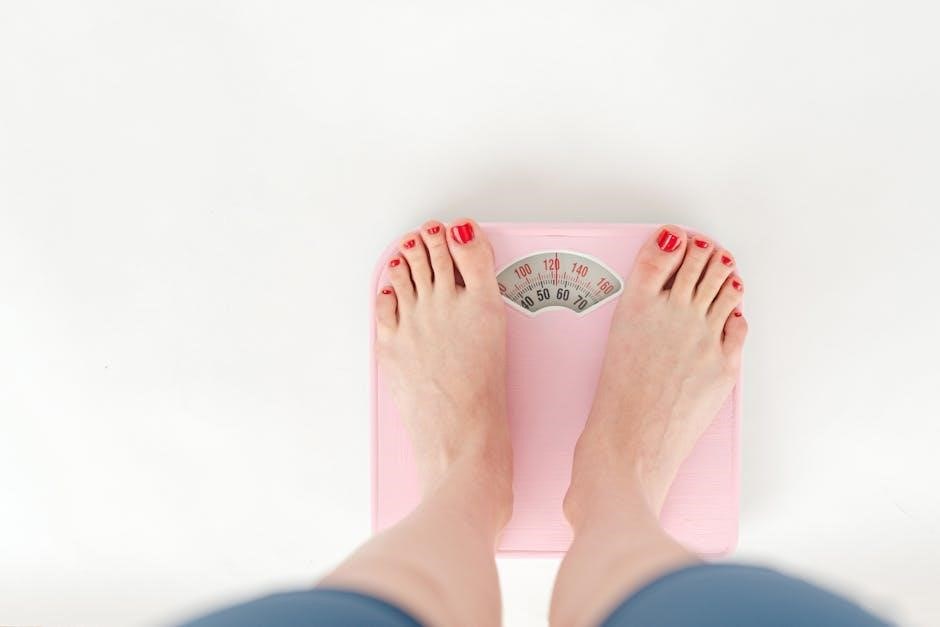
Achieving accurate weight measurements relies heavily on consistent and correct patient positioning. Patients should remove all extraneous items such as shoes‚ heavy jackets‚ and accessories like hats or scarves. Encourage patients to distribute their weight evenly across both feet‚ standing with feet flat on the scale platform and approximately shoulder-width apart.
Avoid leaning against any support – walls‚ furniture‚ or assisting personnel – as this can artificially inflate the weight reading. Individuals with limited mobility may require assistance to maintain a stable‚ upright posture. Ensure the scale is placed on a firm‚ level surface to prevent inaccurate readings due to uneven distribution of weight.
For patients who cannot stand independently‚ specialized weighing chairs or sling scales (not covered in this manual) should be utilized. Consistent positioning is crucial for tracking weight changes over time; therefore‚ strive to replicate the same conditions for each measurement.
Operating Modes: lb/kg Conversion
The Healthometer Professional Scale offers the flexibility to display weight in either pounds (lb) or kilograms (kg). The conversion between these units is typically managed via a dedicated button‚ often labeled “Unit” or “Mode‚” located on the scale’s control panel. Pressing this button cycles through the available units.
To switch from pounds to kilograms‚ simply press the “Unit” button until the “kg” indicator illuminates on the display. Conversely‚ to revert to pounds‚ continue pressing the button until the “lb” indicator is lit. Ensure the desired unit is selected before the patient steps onto the scale for an accurate reading.
Some models may feature a hold function that retains the displayed unit even after the scale is powered off. Refer to the scale’s display panel for confirmation of the currently selected unit before each use. Consistent unit selection is vital for data integrity.
Reading and Interpreting Weight Measurements
Once a stable weight reading is displayed on the Healthometer Professional Scale‚ record the value carefully. The display typically shows weight to a specific resolution (e.g.‚ 0.1 lb or 0.01 kg). Ensure the reading is stable – indicated by a stable icon or consistent digits – before recording.
Consider the patient’s positioning; any movement can affect accuracy. Interpret the weight in the context of the patient’s overall health profile‚ including height‚ age‚ and medical history. Note any unusual fluctuations or discrepancies from previous measurements.
Be mindful of clothing and objects carried by the patient‚ as these contribute to the total weight. Document any such factors alongside the weight reading. Consistent measurement protocols are crucial for reliable tracking and informed clinical decisions.
Advanced Features and Functions
Explore enhanced capabilities like BMI calculation‚ body fat analysis‚ and muscle mass estimation‚ if your Healthometer model supports them‚ for a comprehensive assessment.
BMI Calculation and Interpretation
The Healthometer Professional Scale‚ when equipped with BMI functionality‚ automatically calculates your Body Mass Index (BMI) using your weight and height measurements. BMI is a widely used indicator of body fatness‚ providing a general assessment of whether a person has a healthy weight for their height.
To utilize this feature‚ ensure accurate height input during the setup process or measurement session. The scale will then display your BMI value alongside your weight. Interpretation of BMI values follows standard categories:
- Below 18.5: Underweight
- 18.5 – 24.9: Normal weight
- 25 – 29.9: Overweight
- 30 or greater: Obese
It’s crucial to remember that BMI is a screening tool and doesn’t directly measure body fat. Factors like muscle mass can influence BMI. Consult a healthcare professional for a comprehensive health evaluation and personalized advice based on your individual circumstances.
Body Fat Percentage Measurement (if applicable)
Certain Healthometer Professional Scale models incorporate Bioelectrical Impedance Analysis (BIA) to estimate body fat percentage. This technology sends a harmless electrical signal through the body‚ measuring resistance. Fat tissue offers higher resistance than muscle tissue‚ allowing the scale to calculate an estimated body fat percentage.
For accurate readings‚ follow these guidelines: ensure proper hydration‚ avoid measurements after exercise or consuming alcohol‚ and maintain consistent measurement conditions. The scale will display your body fat percentage alongside weight and potentially other metrics.
General body fat percentage ranges are:
- Essential Fat (5-10% for men‚ 10-13% for women): Necessary for physiological functions.
- Athletes (6-13% for men‚ 14-20% for women): Typically lower due to increased muscle mass.
- Fitness (14-17% for men‚ 21-24% for women): Acceptable for overall health.
- Average (18-24% for men‚ 25-31% for women): Moderate levels of body fat.
- Obese (25% or higher for men‚ 32% or higher for women): Increased health risks.
BIA estimations are influenced by hydration levels and individual variations. Consult a healthcare professional for a comprehensive body composition analysis.
Muscle Mass Estimation (if applicable)
Advanced Healthometer Professional Scale models utilize Bioelectrical Impedance Analysis (BIA)‚ alongside body fat estimation‚ to approximate skeletal muscle mass. Similar to fat percentage measurement‚ BIA assesses resistance to a low-level electrical current. Muscle tissue‚ containing higher water content‚ exhibits lower resistance than fat.
Accurate muscle mass readings depend on consistent hydration‚ avoiding recent exercise‚ and standardized measurement timing. The scale displays estimated muscle mass in kilograms or pounds‚ providing insight into lean body composition.
Muscle mass is crucial for metabolism‚ strength‚ and overall health. Typical ranges vary based on age‚ sex‚ and activity level. Lower-than-expected muscle mass may indicate sarcopenia‚ particularly in older adults.
Remember that BIA provides an estimation‚ not a precise measurement. Factors like hydration and body water distribution can influence results. For a detailed assessment of muscle mass and body composition‚ consult a qualified healthcare professional or utilize more sophisticated diagnostic tools.
Maintenance and Troubleshooting
Regular cleaning with a mild disinfectant ensures hygiene and longevity. Address error codes promptly using the guide‚ and replace batteries as needed for optimal function.
Cleaning and Disinfection Protocols
Maintaining a hygienic surface is crucial in professional healthcare settings. After each patient use‚ the Healthometer Professional Scale’s platform should be thoroughly cleaned. Begin by disconnecting the scale from any power source or external devices. Use a soft cloth dampened with a mild‚ non-abrasive detergent and water solution. Avoid harsh chemicals‚ solvents‚ or abrasive cleaners‚ as these can damage the scale’s surface and internal components.
For disinfection‚ utilize an EPA-registered disinfectant wipe or spray specifically designed for medical equipment. Ensure the disinfectant is compatible with the scale’s materials – consult the scale’s specifications or manufacturer’s guidelines if unsure. Apply the disinfectant according to the manufacturer’s instructions‚ allowing sufficient contact time for effective germicidal action. Wipe down the entire platform‚ including edges and corners.
Follow disinfection with a clean‚ damp cloth to remove any disinfectant residue. Dry the platform completely before the next use to prevent slipping hazards. Regularly inspect the power cord and connectors for damage‚ and clean them with a dry cloth. Never immerse the scale in water or any liquid.
Common Error Codes and Solutions
The Healthometer Professional Scale may display error codes indicating specific issues. “Err 1” typically signals a low battery; replace the batteries immediately. “Err 2” often indicates an overload condition – remove weight until within the scale’s capacity. If “Err 3” appears‚ it suggests an unstable surface; ensure the scale is placed on a firm‚ level floor.
For “Err 4”‚ a communication error with connected devices may be present; check connections and restart devices. If the display shows “—-”‚ it could mean the scale is not calibrated correctly; perform a calibration procedure as outlined in the manual. Persistent error codes despite troubleshooting may indicate a hardware malfunction.
Consult the full manual’s troubleshooting section for a comprehensive list of codes and solutions. If the issue persists‚ contact Healthometer’s customer support for assistance. Do not attempt to disassemble or repair the scale yourself‚ as this may void the warranty and pose safety risks.
Battery Replacement and Care
The Healthometer Professional Scale typically requires standard AA batteries. To replace them‚ locate the battery compartment (usually on the underside of the scale) and open it. Remove the old batteries and insert new ones‚ ensuring correct polarity (+ and -) as indicated. Always use a complete set of new batteries; do not mix old and new batteries.
For optimal performance‚ use alkaline batteries. Avoid using rechargeable batteries‚ as they may not provide sufficient voltage. If the scale is not used for an extended period‚ remove the batteries to prevent corrosion. Dispose of used batteries responsibly‚ following local regulations.
Low battery levels can affect accuracy; replace batteries promptly when the low battery indicator appears. Keep the battery compartment clean and dry to ensure proper contact. Regular battery checks contribute to consistent and reliable operation of your Healthometer scale.
Safety Precautions and Guidelines
Always adhere to weight capacity limits to prevent damage. Avoid use near strong electromagnetic fields. Store the scale properly‚ protecting it from moisture and extreme temperatures.
Weight Capacity Limits
The Healthometer Professional Scale is engineered with a specific weight capacity designed to ensure accurate measurements and prevent potential damage to the internal mechanisms. Exceeding this limit can compromise the scale’s calibration‚ leading to inaccurate readings and potentially voiding the warranty.
Typically‚ Healthometer Professional Scales have a maximum weight capacity of 440 pounds (200 kilograms). However‚ it is crucial to verify the specific capacity listed on the scale’s label or in the accompanying documentation‚ as variations may exist between different models.
Regularly check the scale’s display when weighing patients to confirm that the weight remains within the acceptable range. If a patient’s weight exceeds the limit‚ utilize a higher-capacity scale to obtain an accurate measurement. Never attempt to weigh individuals beyond the scale’s specified capacity‚ as this could result in inaccurate readings and potential safety hazards. Prioritizing adherence to these weight limits will guarantee the longevity and reliability of your Healthometer Professional Scale.
Electromagnetic Interference Considerations
The Healthometer Professional Scale‚ like all electronic medical devices‚ may be susceptible to interference from electromagnetic fields. This interference can originate from various sources‚ including radio frequency (RF) communication systems‚ mobile phones‚ X-ray equipment‚ and other electrical devices. Such interference could potentially lead to inaccurate weight readings or temporary malfunctions.
To minimize the risk of electromagnetic interference‚ it is recommended to operate the scale in an environment free from strong electromagnetic fields. Maintain a safe distance from potential sources of interference‚ such as operating rooms utilizing RF equipment or areas with high mobile phone usage.
Regularly assess the environment where the scale is used for potential interference sources. If interference is suspected‚ try relocating the scale or shielding it from the source. Contact Healthometer’s technical support if you experience persistent issues related to electromagnetic interference‚ ensuring continued accurate and reliable performance of the scale.
Proper Storage and Handling
To ensure the longevity and accuracy of your Healthometer Professional Scale‚ proper storage and handling are crucial. When not in use‚ store the scale in a clean‚ dry environment‚ protected from extreme temperatures‚ humidity‚ and direct sunlight. Avoid storing the scale in areas prone to dust or debris accumulation‚ as this can affect its functionality.
During transport‚ secure the scale properly to prevent damage from shocks or vibrations. Use the original packaging whenever possible‚ or employ adequate cushioning materials. Handle the scale with care‚ avoiding dropping or subjecting it to excessive force.
Regularly inspect the scale for any signs of physical damage. Do not attempt to disassemble or repair the scale yourself; contact authorized Healthometer service personnel for any necessary repairs. Following these guidelines will help maintain the scale’s performance and reliability for years to come.
Technical Specifications
This section outlines key details‚ including dimensions‚ weight‚ power needs‚ and accuracy levels. Precise measurements and reliable performance are guaranteed by these specifications;
Dimensions and Weight of the Scale
The Healthometer Professional Scale is designed for robust use within medical and fitness environments‚ balancing portability with a stable footprint. Its overall dimensions typically measure 12.6 inches (32 cm) in depth‚ 13.4 inches (34 cm) in width‚ and 1.8 inches (4.6 cm) in height. These measurements ensure sufficient surface area for patient comfort and accurate readings.
Regarding weight‚ the scale itself is relatively lightweight for easy transport and storage‚ generally weighing around 8;8 pounds (4 kilograms) without batteries. This manageable weight allows healthcare professionals to easily move the scale between examination rooms or utilize it for mobile health applications. The compact design and reasonable weight contribute to its versatility and practicality in diverse healthcare settings. These specifications are crucial for logistical considerations and integration into existing workflows.
Power Requirements
The Healthometer Professional Scale primarily operates on battery power‚ offering flexibility and portability for use in various locations without direct access to electrical outlets. It typically requires four AA-sized alkaline batteries to function optimally. The recommended battery type is crucial for ensuring accurate readings and prolonged operational life; avoid using rechargeable or lithium batteries unless specifically approved by the manufacturer.
Battery life varies depending on usage frequency and display brightness settings‚ but generally provides several months of operation under normal conditions. A low battery indicator is incorporated into the display to alert users when replacement is necessary‚ preventing unexpected interruptions during measurements. The scale does not typically support a direct AC power adapter‚ emphasizing its reliance on battery power for convenient and mobile operation. Proper battery installation and maintenance are essential for consistent performance.
Accuracy and Resolution
The Healthometer Professional Scale is engineered for high accuracy‚ providing reliable weight measurements crucial for medical and fitness applications. Its accuracy is typically specified within ±0.1 kg (or ±0.2 lb) under ideal conditions‚ ensuring precise readings for patient monitoring and health assessments. Resolution refers to the smallest increment the scale can display‚ commonly 0.1 kg or 0.1 lb‚ allowing for detailed tracking of weight changes.
Factors influencing accuracy include proper calibration‚ stable surface placement‚ and correct patient positioning. Regular calibration is recommended to maintain optimal performance and compensate for potential drift over time. The scale’s internal sensors and processing algorithms contribute to its precision‚ minimizing errors and delivering consistent results. Understanding these specifications is vital for interpreting weight data accurately and making informed decisions regarding health and wellness.